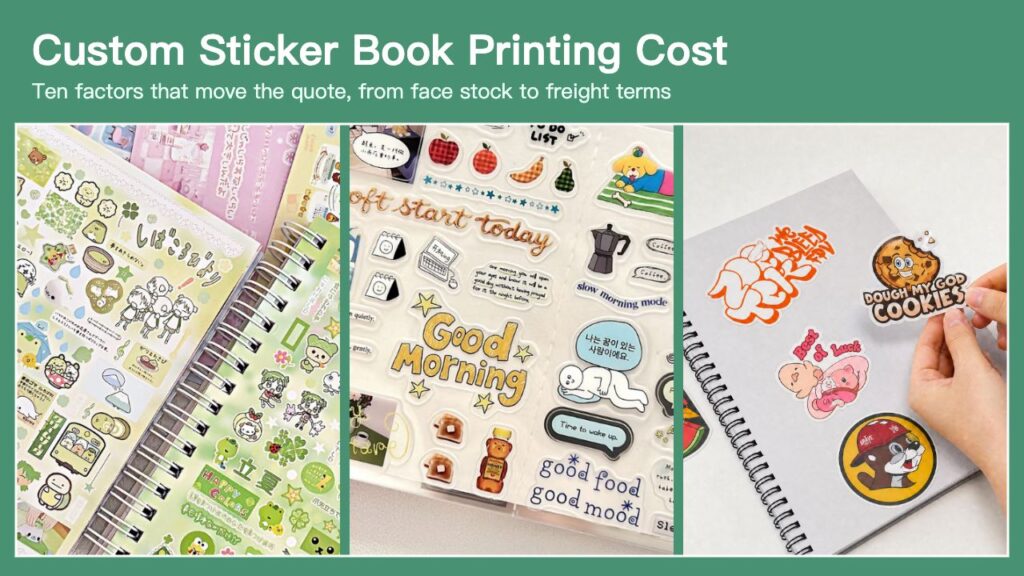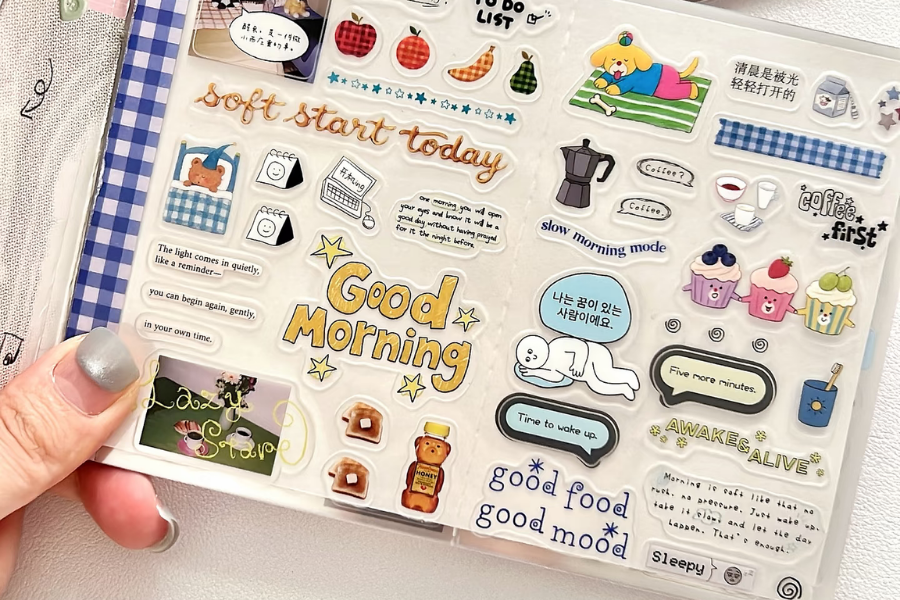


A sticker book looks like the cheapest item on an activity table. The quotations for one rarely behave that way. Price moves with the face stock, the adhesive, the sheet count, the cut lines, and the binding.
Ten decisions carry most of that movement. Each one has a stated range or a published limit on our own product and support pages, so you can put identical wording in front of every supplier you ask.
This guide stays on cost. If you still need to settle the format, our rundown of custom sticker book types walks through scene books, planner books, and collectible albums instead.
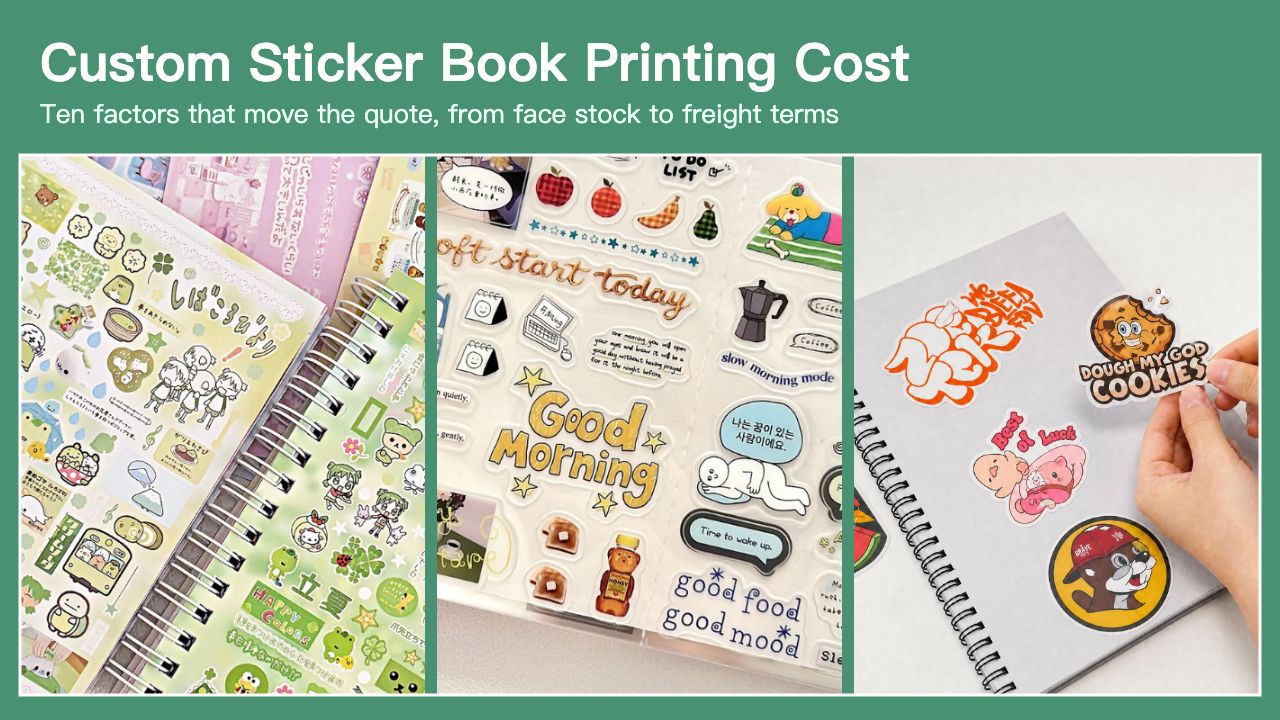
The same request can land across a wide price band when these ten lines stay blank, because every supplier fills them with its own default.
Face Material Sets The Price Floor
Our sticker book page lists face stocks running from glossy art paper through waterproof vinyl to eco-friendly kraft. Those are not three names for one sheet. Peso, revestimiento, and ink behaviour all change with the choice.
Coated paper sits at the low end. Our paper stock reference puts gloss coated at 80 a 250 gsm and matte coated at 80 a 300 GSM, the same families that carry printed activity pages.
Weight also sets thickness. That reference gives a single 80 gsm offset sheet a caliper around 0.095 mm, mientras 157 gsm gloss coated reaches roughly 0.133 mm.
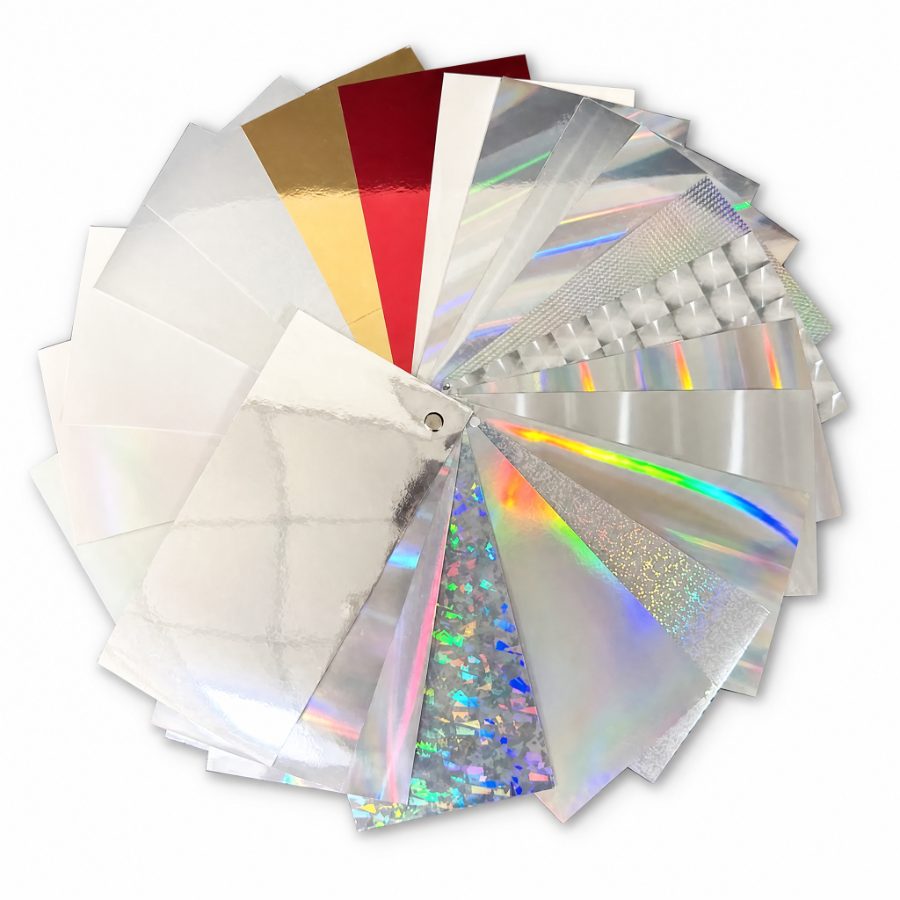
Film stocks sit above paper on both purchase price and press time. Transparent PET can need a white underprint so selected colours read on a clear sheet, and vinyl behaves differently through a press than a coated sheet does.
Metallic and holographic stocks add the same handling plus extra proofing. Kraft and recycled stocks trade print sharpness for texture, and our pages list recycled eco paper at 70 a 140 GSM.
Adhesive Type And Reuse Cycles
Our product page states support for kiss-cut sheets and a permanent adhesive option. Anything beyond that is a separate stock decision rather than a default, and it belongs on your specification as its own line.
Removable and repositionable systems are different adhesives, not weaker versions of the permanent one. Each is quoted against the stock it releases from, which is why two books called reusable can price apart.
Release behaviour depends on the whole stack: face material, adhesivo, page coating, and handling. A mismatch shows up as lost tack, curling edges, or residue, so test the pairing you intend to ship.

Our guide to libros interactivos personalizados treats the reusable page as a build decision, not a material.
Page Count And Sheet Count
Two counters drive a sticker book, and suppliers confuse them easily. Pages are the printed cards between the covers. Sticker sheets are the kiss-cut sheets a reader peels from. Only one of the two carries face stock, adhesivo, and liner at once.
Our product page publishes recommended pairings by market segment, a useful first sanity check on a quote. Read the sheet column as the cost signal, the page column as paper and print.
| Market segment | Recommended size | paginas | Sticker sheets |
|---|---|---|---|
| Aprendizaje preescolar | A5 | 16 a 24 | 2 a 4 |
| Children’s publishing | A4 | 24 a 48 | 4 a 8 |
| Retail activity books | A4 | 32 a 64 | 4 a 10 |
| Libros de pegatinas reutilizables | A5 or square | 8 a 16 | 5 a 10 |
| Campañas promocionales | A5 | 8 a 24 | 2 a 6 |
| Museum and attraction gifts | A5 | 16 a 32 | 2 a 4 |
The reusable row shows the trade clearly: the fewest pages of any segment, 8 a 16, yet 5 a 10 sheets. That book is sticker-heavy by design, and its cost sits in the sheets.
Trim Size And Sheet Layout
The same six segments list A5 and A4 as their recommended sizes, with a square option for reusable books. Trim size is decided before the artwork exists, and it sets how many pages fit on one printed sheet.
Layout is where a small change saves real money. Two titles that share a cut pattern can differ by a few millimetres and still land on different sheet sizes, and the second wastes more paper per run.
A size outside those two is a separate conversation. Imposición, dies, and cartons all get re-planned, so raise it before a proof rather than after.
Cut Lines, Peelability, And Tooling
Kiss-cutting cuts the face stock and its adhesive while leaving the backing liner whole. That is what keeps a sticker sheet usable as a sheet. Die-cutting cuts through the full stack to produce a loose shape or a specific outline.
Our product page puts one hard number on the layout: dejar al menos 2 mm between cut lines so stickers peel cleanly. Artwork that crowds the cut line produces a book that frustrates the person using it.
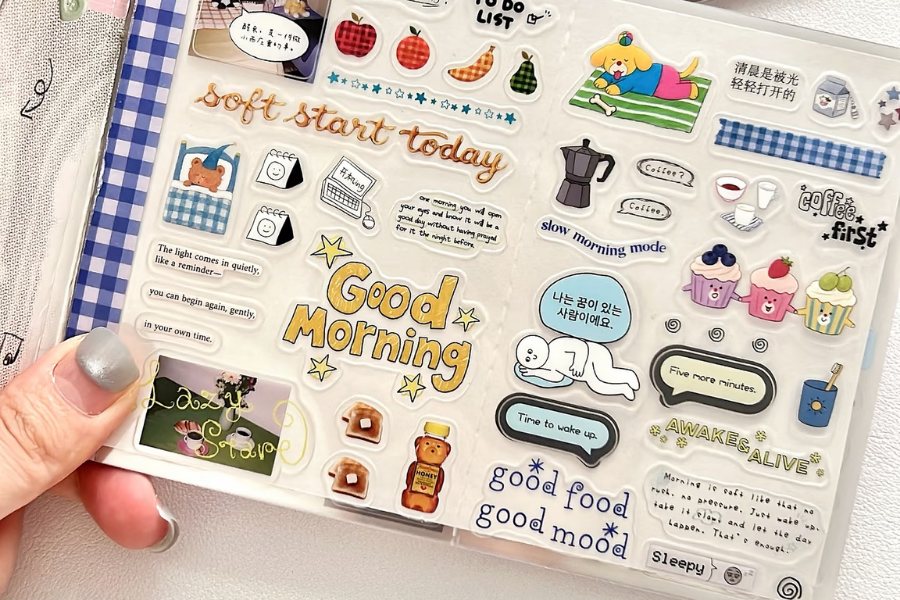
Tooling is where the cut cost concentrates. Each shape family needs its own blade work, so ten repeated stickers cost less to prepare than fifty unique ones. A cover window or shaped edge adds a die of its own, listed under opciones de acabado as steel blade die-cutting.
Depth matters as much as the outline. A shallow cut leaves stickers hard to lift, and a cut through the liner tears the sheet. Drifting registration shows up as uneven white borders.
Ink Set, Platos, And Quantity
Sticker book artwork reaches us in CMYK at 300 ppp, con 3 mm de sangrado y un 5 mm safety margin. Our file guidance asks for print-ready PDF in PDF/X-1a or PDF/X-4, worked in FOGRA39 or GRACoL2006.
Four process colours print as one plate set. A brand colour that falls outside that gamut needs a spot ink instead, and our pages describe custom fifth and sixth Pantone formulations for exactly that case. Each extra unit is extra ink and extra press work on top of the CMYK set.
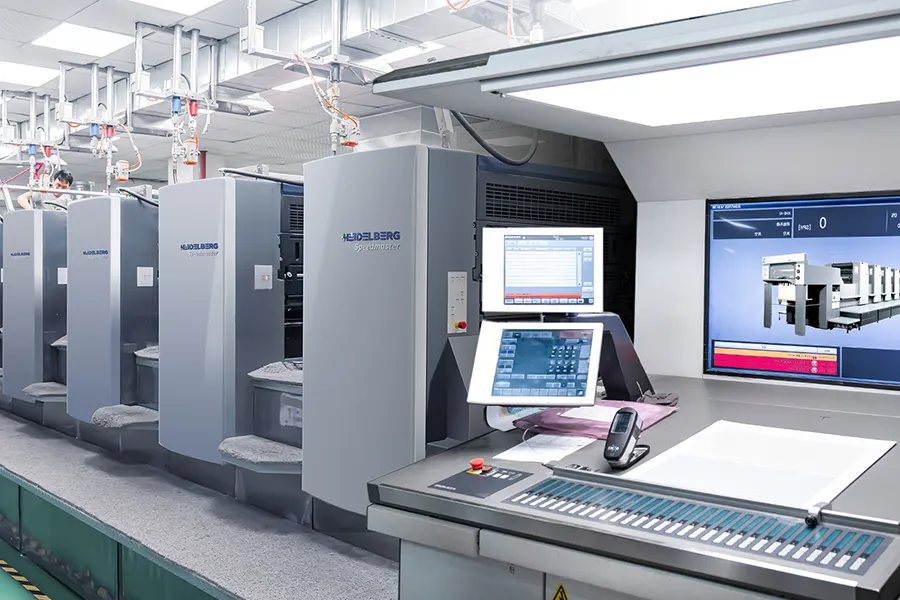
Quantity spreads that fixed work. Offset setup covers plates, calibración de la máquina, y troqueles plegables, so our minimum sits at 200 copies and the per-copy share falls as the run grows. Order tiers on our pages run 200, 500, 1,000, and above.
Digital printing avoids part of that setup, which is why short runs and version tests usually land there. Longer runs are where a conventional offset press changes the unit price.
Cover Finishes And Embellishments
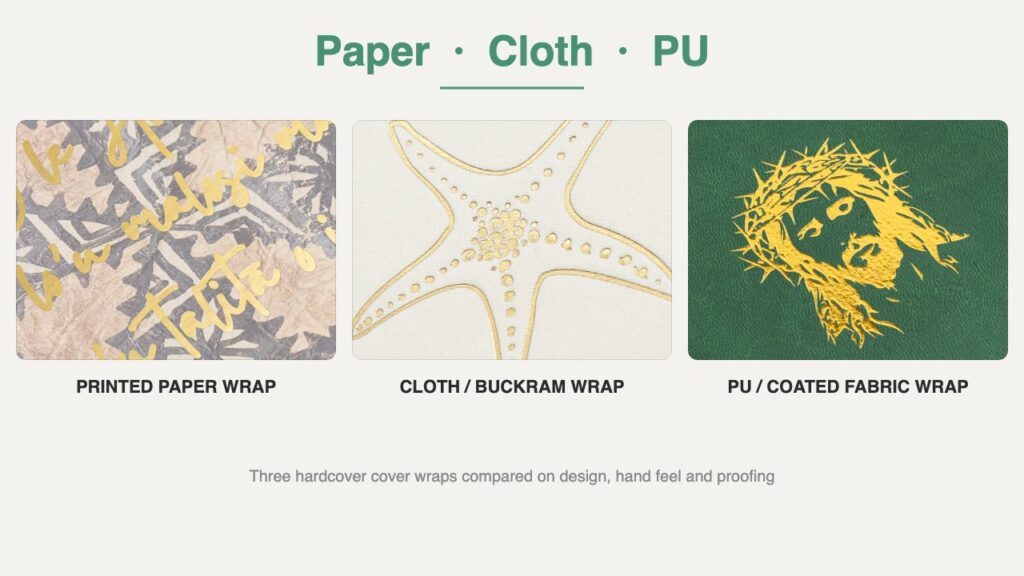
Every finish is a separate pass with its own tooling, and each adds to the per-copy line rather than to setup. Matte or gloss lamination is the base, described on our finishing page as the protective layer under the rest.
That page publishes minimum line weights you can check your artwork against before asking for a price. Spot UV and raised UV start at 0.50 mm. Hot foil stamping holds at 0.25 mm, blind debossing at 0.30 mm, and raised embossing at 0.40 mm.
Substrate narrows the options. The same table marks Spot UV as bleeding on uncoated and kraft stock, and lamination as not applicable to linen bookcloth. A tactile cover on a recycled face costs more engineering than it suggests.
Edge work sits in the same category. Sprayed edges need artwork at 300 ppp, and gilding is a foil pass on a trimmed block. A window die adds cut and finish in one step.
Binding Choice And Hardware
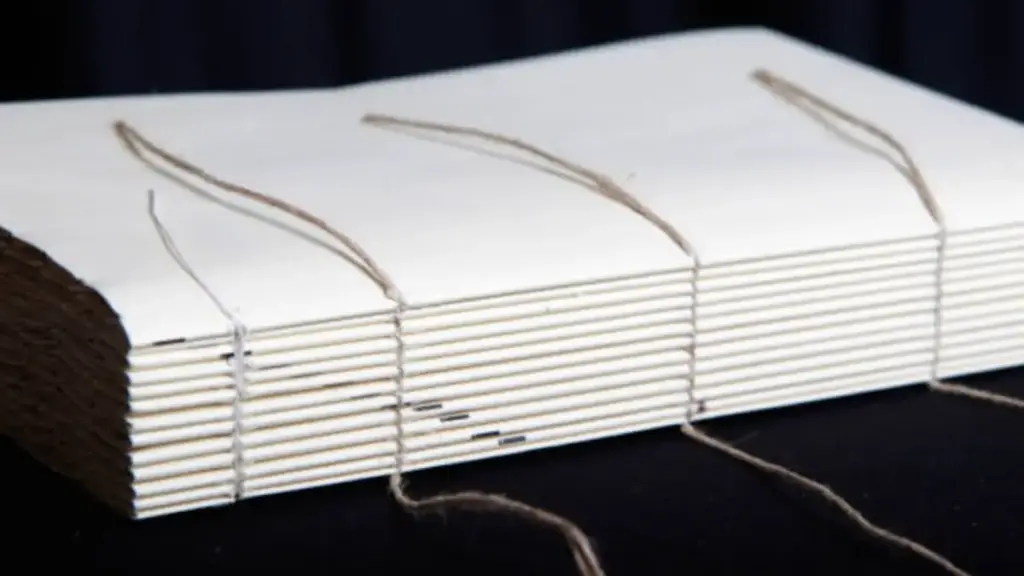
A sticker book opens flat or it fails, so binding is a usability decision that arrives as a cost line. Our binding reference publishes page ranges and a relative cost level for each structure.
| Estructura | Published page range | Lay-flat | Cost level |
|---|---|---|---|
| Cosido a lomo | 8 a 64, in multiples of 4 | Opens fully flat | $ |
| Wire-O or double loop | 16 a 400+ | Turns 360 grados | $$ |
| EVA perfect binding | 48 a 400 | Rígido | $$ |
| Encuadernación perfecta PUR | 48 a 600+ | Moderado | $$$ |
| Children’s board book | 10 a 36 | Opens fully flat | $$$$ |
Twin-loop wire adds a punch step and a metal coil that glued structures avoid, and buys the 360-degree turnover a sticker page needs. Saddle stitch is cheaper and lies flat, yet its 64-page ceiling and multiple-of-4 rule constrain the page plan first.
PUR sits a level above EVA because our reference rates it at roughly three times the pull strength of standard hot-melt glue, with better temperature resistance.
Proofing Rounds Before Production
Setup lines get compared closely, while proofing sits at the bottom of the quotation and moves the calendar. Our proofing page publishes both stages: a digital PDF proof inside 12 a 24 horas, and a physical press proof in 5 a 7 working days plus express shipping.
A screen cannot settle paper, colour, or relief. The proofing page marks texture, ink absorption, and foil depth as press-proof items only, which is why the sample protects the run.
Cost behaves differently here. The digital proof is free on every project, and the sample charge is credited against the production invoice once the order reaches our standard minimum. Each extra round still carries 5 a 7 dias laborables, which is what hits a launch date.
Embalaje, Safety Work, And Freight
Packing is a specification rather than a default. Our shipping guide describes double-wall export cartons around 7 mm de espesor. Each carton stays under 15 kg gross, stacked on ISPM 15 pallets with corner boards and stretch wrap.
Retail-ready options sit on top of that base. Shrink wrap, bandas del vientre, and sleeves are available per request, and each adds a handling step your quote should show as its own line.

Safety work is the line buyers forget to price. A sticker book sold to children can fall under toy rules in the destination market, and our pages list EN71 and ASTM for face stocks. The US Consumer Product Safety Commission explains when a children’s product needs toy safety compliance under federal rules. Naming a standard on a spec sheet is not the same as a test report for your SKU, so ask which document backs the claim.
Freight follows the term you buy. El Incoterms rules from the International Chamber of Commerce define what each term covers, y nuestro shipping guide lists the four we quote. Published windows include 10 a 50 days by ocean and 9 a 12 days by air to the United States.
Build One Comparable Quote Sheet
Send the same eleven lines to every supplier and the differences stop being mysteries. Anything left out comes back as a variation, usually after a delivery date is booked.
| Line item | What to state | Why it moves price |
|---|---|---|
| Cantidad | One of 200, 500, 1,000, o más | Splits fixed plate and die work |
| Tamaño de corte | A5, A4, or a named custom size | Sets imposition and paper waste |
| Pages and sheets | Both counts, separately | Sheets carry stock, adhesivo, liner |
| Face material | Named stock with gsm | Film, metallic, and kraft cost more |
| Adhesivo | Permanent, desmontable, or repositionable | Different stock, tested release |
| Cut file | Shape count, outline detail, 2 mm spacing | Each shape family is blade work |
| Ink set | CMYK plus any Pantone spot colours | Extra units mean extra passes |
| Acabados | Laminación, frustrar, Uva, realzar, edge work | One pass and one tool each |
| Vinculante | Structure plus hardware size | Punching and coil are added steps |
| Corrección | How many physical rounds | Each round is days, not hours |
| Trade term | EXW, ENGAÑAR, CIF, or DDP with a postal code | Changes duty, transporte, and risk |
Ask for the eleven lines itemised, not a single landed unit price. An itemised quote is the only one you can renegotiate after a specification change.
Schedule follows the same sheet. Our buyer FAQ publishes mass production at 7 a 12 business days for paperbacks, y 10 a 18 para tapas duras encuadernadas. That clock starts at proof approval, a signed spec sheet, and a confirmed deposit. A sticker book lands inside one of those windows by binding, so request the figure for your structure.
Two further terms matter for repeat business. Payment typically runs a 30% a 50% deposit against the balance, settled after you review final inspection records. Files and plates stay on record for 2 años. The minimum reprint quantity is 200 copias, so a second run should not repay setup you already covered.
Check The Quote, Not The Promise
Before you compare two numbers, confirm both describe the same specification. These checks expose a quote that looks cheap because it left something out.
- Sheet count stated separately from page count. A quote that merges them is describing a different book.
- Face material named with gsm. «Sticker paper» is not a specification, and film and paper price apart.
- Adhesive type and release surface. Ask what it releases from, then test that pairing.
- Die and tooling ownership. Confirm who holds the die and what a change costs.
- Ink set spelled out. CMYK plus named Pantone spot colours, no «full colour».
- Finishes listed one per line. Each pass and each tool should be visible on the sheet.
- Trade term with a destination. A unit price without a named Incoterm is not comparable.
Sticker Book Quotes Itemised Line By Line
Pensamientos finales
Sticker book cost is not a mystery rate. It is the sum of ten decisions, and each one has a published limit. Material, adhesivo, page and sheet counts, tamaño de corte, and cut tooling come first, then ink set, acabados, vinculante, pruebas, embalaje, y flete.
Fill those lines before you ask for a price and the quotations come back comparable. Xinyi publishes the ranges used above on its own product and support pages, and you can read them directly on the pagina de inicio.
Cost work on a related format has its own guide: what it costs to print a coloring book follows the same itemised logic on a paper-only product.
Preguntas frecuentes
What is the minimum order quantity?
Our standard production minimum is 200 copies across custom printed products. Offset setup covers plates, calibración de la máquina, y troqueles plegables, so the fixed share falls as quantity rises. Order tiers on our pages start at 200, then 500 y 1,000.
Why does a sticker book cost more?
Three components an activity book does not carry: face stock for the stickers, the adhesive system, and the release liner. Each sticker sheet adds all three, plus the cutting pass that makes the stickers peelable. Page count alone will not explain the gap.
Are reusable sticker books more expensive?
Usually, because a repositionable adhesive and a matching page surface are specified rather than assumed. Our product pages pair reusable books with 8 a 16 pages and 5 a 10 sheets, so the sticker area is high relative to the paper in the book.
Does holographic stock cost more than vinyl?
Both sit above coated paper on our published range, and they raise different costs. Vinyl is a synthetic sheet that changes press handling. Holographic and metallic stocks reflect light, which affects colour reading and adds proofing time before a run is approved.
Is a physical sample worth the wait?
When adhesive, paper texture, and foil relief all decide whether the product works, Sí. A press proof takes 5 a 7 working days plus shipping, and the fee is credited against the production invoice once the order reaches our standard minimum.