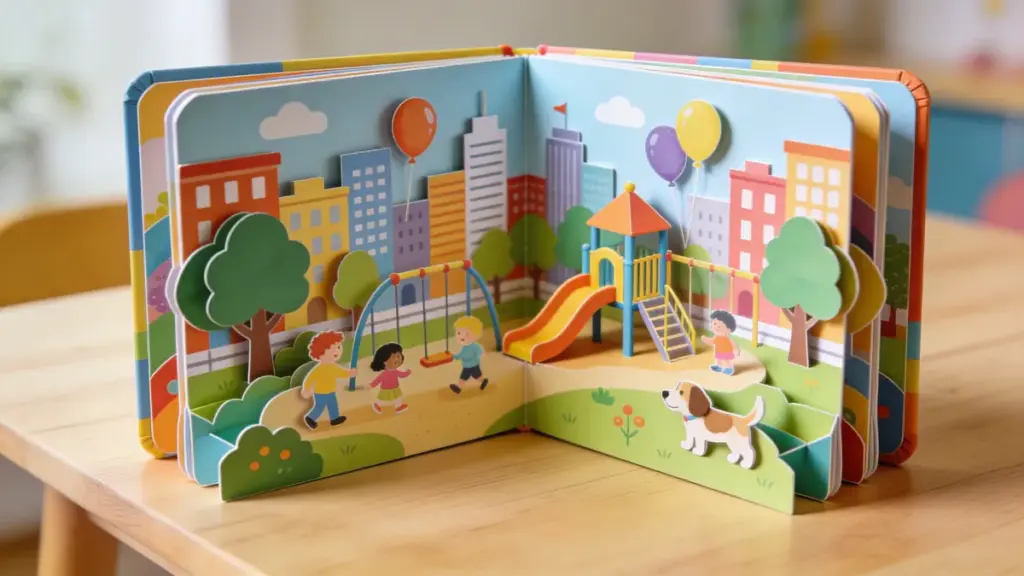


A pop-up book is a printed book whose pages carry die-cut paper structures that rise, slide, or turn when a page opens. The parts are cut flat, folded by hand, and glued into the spread, so the finished book has to work in two directions. It stands up when opened and closes flat without tearing, creasing permanently, or popping the cover.
That double requirement changes how you brief a factory. The mechanism list, the board, the dieline layers, and the sample checks all move onto the specification sheet. This guide covers the mechanism families on our own product pages, the two format routes, and the file and sample stages before mass production.
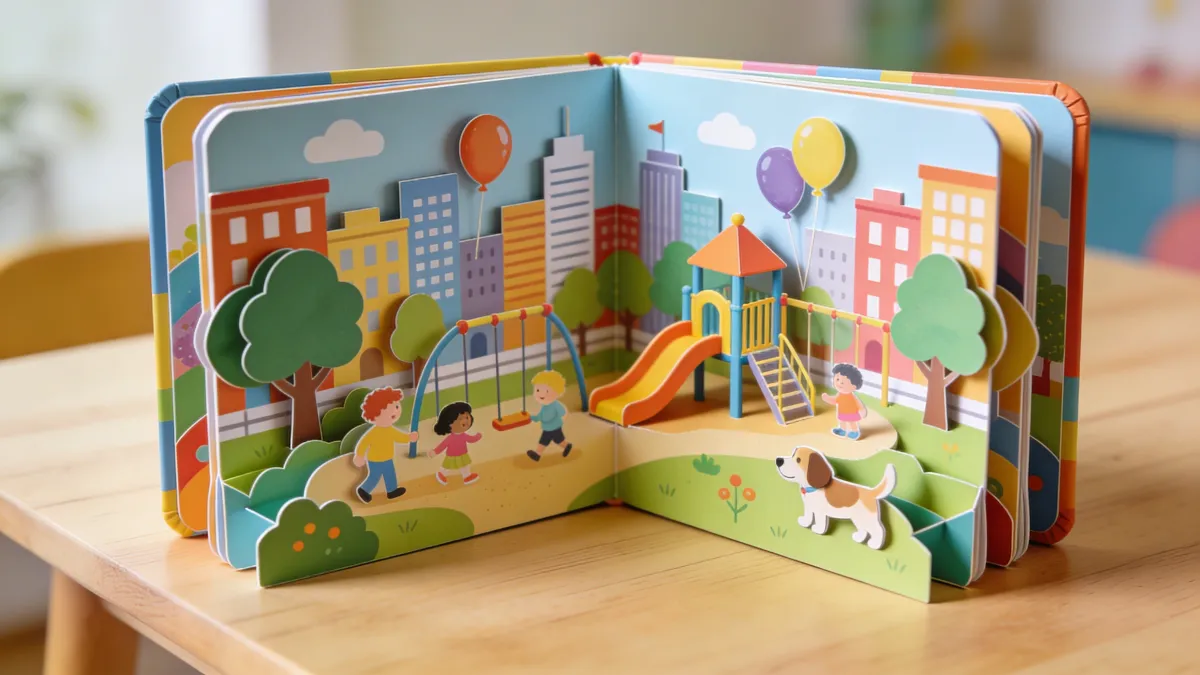
What A Pop-Up Book Actually Is
The umbrella term covers any book with three-dimensional pages, including movable elements that rise as a page turns. The pop-up book overview on Wikipedia lists the family names collectors use: pop-ups, tunnel books, transformations, volvelles, flaps, pull-tabs, and pop-outs. Designing those pages is called paper engineering.
Our product pages use a shorter, ordering-facing list. Every pop-up title we quote carries a mechanism line reading 2D or 3D pop-up, pull tabs, flaps, and rotating parts, plus a structure grade of simple pop-up or multi-layer interactive. Those two rows are what a quotation prices, and they sit inside the wider interactive category explained in our custom interactive books guide.
Name the mechanism, the board, the glue points, and the dieline layers as four separate lines, and quotes from different suppliers become comparable.
Mechanism Families On The Spec Sheet
Most titles combine two or three mechanisms rather than one repeated effect. The table below keeps to the four families our product pages publish, and adds the failure each one exposes during sampling.
| Mechanism | What it does | What to watch on a sample |
|---|---|---|
| 2D and 3D pop-up | Layered cut sheets rise from the spread into a standing scene | Layers that slump, or a scene that will not close flat under the cover |
| Pull tabs | A pulled tab moves an element up, across, or out of a window | Sticky travel, or the anchor point tearing where the tab meets the page |
| Flaps | A hinged paper door lifts to reveal a second image underneath | A crease that lifts at the corner, or a flap that no longer lies flat |
| Rotating parts | A pinned disc turns behind a window so two layers read together | Binding at the window edge, or an off-centre pin that rubs |
Structure grade is the second axis. A simple pop-up carries one effect per spread, while a multi-layer interactive title stacks several cut layers on the same page. That grade drives die count and assembly minutes more than page count does.
Pull Tabs And Sliding Elements
A pull tab converts a straight pull into movement elsewhere on the spread. The tab is anchored to the page, routed through a slot, and joined to the element that moves. Travel distance and slot length set how far that element goes, so the mechanism is planned against the trim size rather than drawn first.
Friction is the variable a photo cannot show. Cut edges must be clean and the guide slot wide enough to move under a light, steady pull. On the approved sample, cycle the tab several times and watch the anchor point, where a weak joint fails first. Our dinosaur pop-up build shows a scene-led version, where layered cuts and pulled elements share one spread.

Flaps And Rotating Parts
Flaps are the cheapest way to add a reveal, and the finishing page lists flap doors among the shapes its steel blade dies cut. A flap is a paper hinge, so its score line carries the wear. Repeated lifting opens the crease at the corners first, so agree flap stock and crease depth before tooling.
Rotating parts are the disc-and-window mechanism that collectors call a volvelle. Concentric layers are pinned at one centre and read through an opening, so tolerance between disc and window decides whether the part turns or jams. In the spread below, a round turntable sits in front while cut layers build depth behind it.

Layered Scenes And Paper Houses
Depth comes from stacking cut layers, each printed and trimmed to its own contour. A multi-layer scene reads as foreground, middle, and background when the page opens, then collapses into the gutter when it closes. The limit is total collapsed height, since every layer adds paper under the cover.
Tunnel and diorama builds frame several layers through arches, so the reader looks through the book instead of at it. Those units are assembled station by station, which is why a boxed structure is quoted on assembly minutes as much as on material. Our adult pop-up books page covers the taller end of this range.

Board Pages Or Paper Text Blocks
Two constructions carry almost every order. The board version is built for young hands, the paper version for taller structures and older readers. Our published parameters set the difference.
| Parameter | Board pop-up | Paper-text pop-up |
|---|---|---|
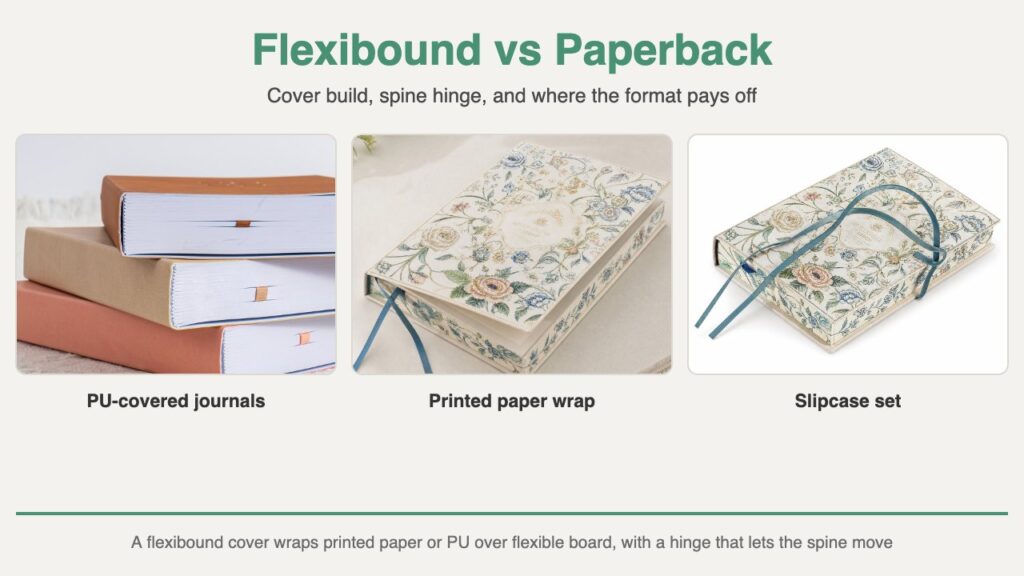
| Binding | Board book binding | Hardcover case binding or flexibound |
| Cover material | 2 mm or 2.5 mm greyboard with art paper | Greyboard with coated paper, 157 gsm art paper as the example |
| Inner pages | Same stock as the cover | 200 to 300 gsm coated or specialty paper |
| Page count | Board titles run short, and our binding table puts board books at 10 to 36 pages | Custom, typically 8 to 24 pages |
| Size examples | 150 x 150 mm or 180 x 180 mm, customised to brief | A4 or 210 x 210 mm, customised to brief |
| Corners and glue | Rounded or square corners, child-safe non-toxic glue | Matte or gloss lamination, spot UV, foil stamping on the cover |
Board pages are stiff, so mechanisms glue onto a solid substrate and survive rough handling. Paper text blocks are lighter, which lets a structure stand taller before the book stops closing. The board construction itself is covered in our board book guide, and the 3D pop-up board book page carries the parameters quoted above.

Sizes And Page Counts That Work
Page count on a pop-up is a spread budget, not a text length. The product pages list custom counts at typically 8 to 24 pages, and our board book page count guide explains why board titles sit at the short end. Each engineered spread needs a partner page to receive it, so read a mechanism plan two pages at a time.
Trim size sets what a mechanism can do. Square formats keep a scene centred over the gutter, which suits standing layers. A wide horizontal trim opens further for staged scenes but leaves less depth for a tall structure to collapse into. Either way, the finished size is confirmed against a dieline before artwork locks, because spine and wrap allowances move with board thickness.
Dielines And Artwork Layer Rules
A pop-up file is not a normal print PDF with extra pages. Structure lives on separate vector layers, and the file setup and templates page publishes the rules our prepress team checks.
| Layer or item | Published rule | Why it matters here |
|---|---|---|
| Die_Cut layer | 100% vector stroke with no fills, red stroke for cut lines, green stroke for fold creases | One mixed layer cannot be checked against the die, so errors surface after tooling |
| Template guides | Delete dieline guides, trim marks, comments, and hidden template layers before export | Leftover guides print as ink or cut as blades |
| Bleed and safety | 3 mm outer bleed past the trim line, with critical content held inside the safety margin | Die-cut edges trim closer than a normal page, so short bleed shows as white lines |
| Special finish layers | Foil minimum stroke 0.15 mm and minimum font 8 pt, Spot UV minimum line 0.20 mm, emboss minimum stroke 0.25 mm | Thin dies clog or tear fibres, and a failed relief cannot be fixed at binding |
| Hinge clearance | Keep foil, Spot UV, and embossing 8 to 10 mm clear of hinge grooves and fold creases | Finish film stiffens a crease, and a stiff crease cracks on the first opens |
| Custom dielines | CAD engineers generate a bespoke dieline within 12 to 24 hours once paper stock and page count are confirmed | Structure cannot be engineered on a template built for another stock |
Prepress verifies machinability, not your manuscript. The published split is explicit. The factory checks resolution, bleed, colour mode, separation layers, and spine maths. Spelling, page order, and image rights stay with you. Read that boundary as a schedule item, since a text fix after dieline approval moves the tooling too.
Cutting, Finishing, And Assembly
Sheets print first, then take finish, then get cut. Pop-up interiors stay uncoated or lightly finished where the folds work. Lamination, spot UV, and foil are reserved for the cover, since a film finish across a crease is a cracking risk. The finishing options page lists custom steel blade dies for cut-out windows, flap doors, and notched covers, the tooling a mechanism spread relies on.
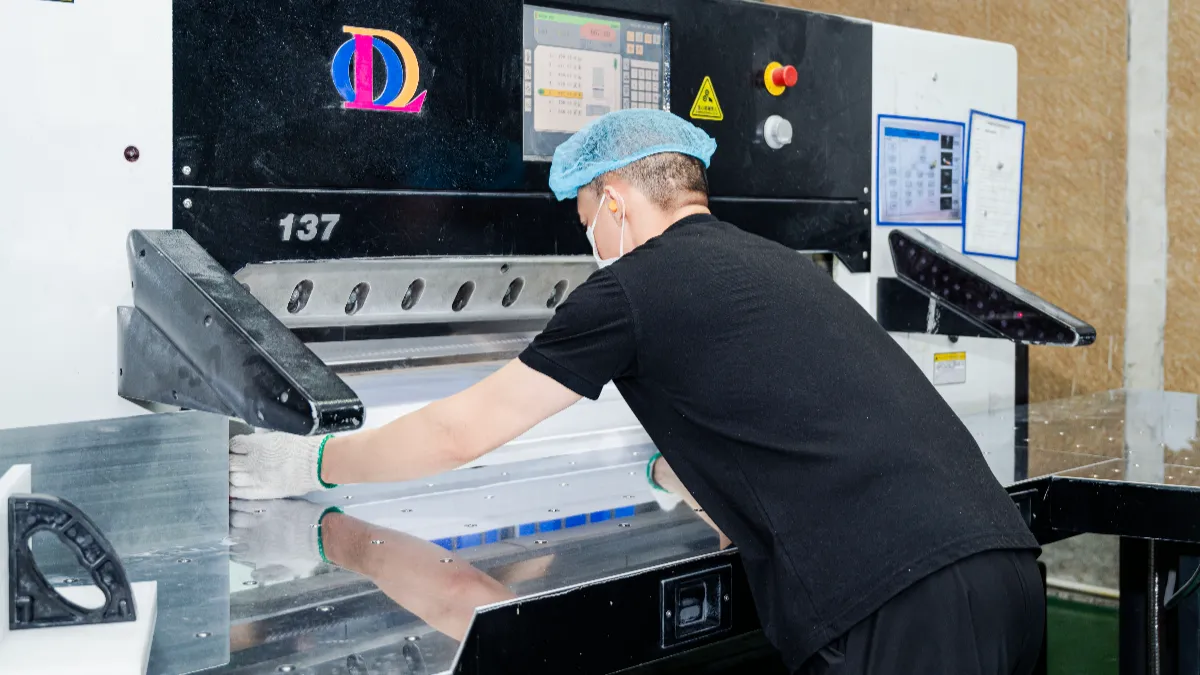
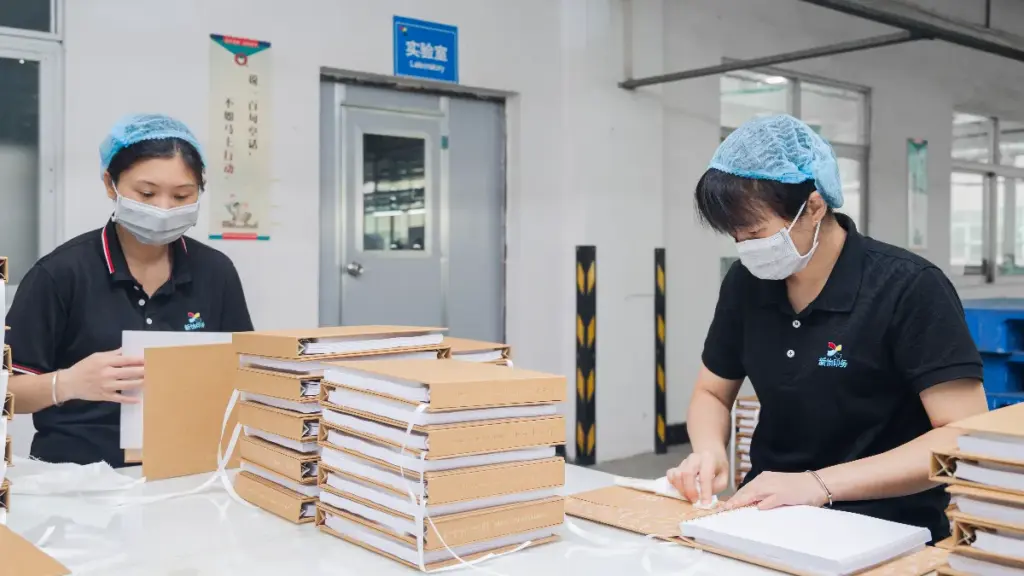
Assembly is the step that separates this category from ordinary book work. Operators fold each element, glue it into the text block, fit tabs and discs, and hinge the covers, so labour is counted per unit. That is why structure grade moves price as much as paper does, and a mechanism added late costs more than its parts.
Our bulk-order guide publishes an eight-stage inspection sequence for hardcover production, from prepress file checks through paper, printing, binding, case-making, casing-in, final product, and packing. Pop-up titles ride the same sequence with one addition. The mechanism is verified against the approved sample at the assembly station, not only at the end of the line.

Proof Stages Before Mass Production
Structure is proved physically, because a screen cannot show a fold. The product pages list a free sample stage in three tiers: a digital sample, a blank sample, and a completed sample. The proofing and samples page sets the timing. A digital PDF proof returns in 12 to 24 hours. A physical press proof takes 5 to 7 working days, plus 3 to 5 days of express shipping.
The two proofs answer different questions. A PDF checks page order, imposition, and text. It cannot judge paper texture, caliper, or the relief of foil and embossing. The physical copy settles whether a mechanism rises and closes, so its fee is credited back once an order reaches the standard minimum. Files and plates stay on record for 2 years, and a reprint starts from those records with a 200-copy floor.
What To Check On The Sample
Write the acceptance list before the sample ships, then judge the bulk run against the retained copy. These are the checks a mechanism book needs that a flat book does not.
| Check | How to test it | Defect it catches |
|---|---|---|
| Mechanism rise | Open the spread slowly and watch each element reach its standing position | Slumped or leaning layers |
| Tab and disc travel | Cycle every moving part through its full range and feel for catching | Sticky slots, jammed windows, rubbing pins |
| Flat closure | Close the covers and look for pages standing proud or a warped board | Collapsed height that exceeds the case |
| Crease and glue lines | Open and close repeatedly, then inspect crease valleys and every anchor point | Cracked scores, cold glue spots, lifting corners |
| Packed transit | Ship one packed unit to yourself and open it on arrival | Crushed corners and detached elements in transit |
Packing is part of the test. The shipping and delivery page describes double-wall export cartons kept under 15 kg per box, stacked on ISPM 15 pallets with corner protection and moisture barriers. Published transit windows to the United States run 10 to 50 days by ocean and 9 to 12 days by air.
Safety Rules For Children’s Markets
Most pop-up titles sell to children, so material and hazard questions arrive early. The product pages list EN71, CPSIA, and FSC as available, describe rounded corners as a safety option, and specify child-safe non-toxic glue. The compliance and certifications page adds that children’s products may carry further safety requirements, naming CPSIA and ASTM for the US market.
The CPSC toy safety guidance explains that ASTM F963 is a mandatory standard for toys sold in the United States. It sets lead limits for surface coatings and separate rules for small parts. Naming a standard on a purchase order is not a test report for your SKU. Bring the destination market into the quotation and agree who pays for testing.
Build One Comparable Brief
- Mechanism list. Name each spread by family, and mark it simple pop-up or multi-layer interactive.
- Format route. Board pages on 2 mm or 2.5 mm greyboard, or a paper text block on 200 to 300 gsm stock.
- Structure maths. Trim size, page count, and the collapsed height every layer must fit inside.
- File state. Separate die-cut layer with red cut and green crease strokes, guides deleted, 3 mm bleed applied.
- Finish map. Lamination, foil, or spot UV on the cover, and finishes held clear of hinge creases.
- Sample plan. Digital proof, blank sample, then a completed physical sample signed off at both ends.
- Quantity and terms. Order tiers start at 200 copies, with a deposit of 30% to 50% and a named delivery term.
- Market. Destination country, age band, and which test reports you expect to receive.
Pop-Up Quotes Built From The Mechanism Up

Final Thoughts
A pop-up cost is not a mystery rate. It is the sum of the mechanism list, the format route, the die plan, the assembly minutes, and the sample rounds. Each one has a published line on our product and support pages.
Fill those lines before asking for a price and quotations come back comparable. The pop-up book category shows finished examples across children’s and adult titles, and our contact page takes a brief with your structure notes attached.
Related format work has its own references. Board book versus hardcover versus paperback compares the page stocks a pop-up can sit on. Book spine types covers the hinge layer a mechanism spread loads.
Frequently Asked Questions
What is the minimum order quantity?
Standard production starts at 200 copies, with order tiers at 200, 500, 1,000, and above 1,000. Offset setup carries fixed costs, so the per-copy share falls as the run grows. An itemised quotation usually returns within 12 to 24 business hours.
Can I see a sample before ordering?
Yes. The sample stage covers a digital sample, a blank sample, and a completed sample. A digital PDF proof returns in 12 to 24 hours, and a physical press proof takes 5 to 7 working days plus 3 to 5 days of express shipping.
How long does production take?
The product pages publish a lead time of 10 to 15 days after the deposit is received and the proof is confirmed. Transit adds 10 to 50 days by ocean or 9 to 12 days by air to the United States, counted separately from production.
What paper do pop-up pages use?
Paper-text titles use 200 to 300 gsm coated or specialty paper with a greyboard cover faced in 157 gsm art paper. Board titles are built on 2 mm or 2.5 mm greyboard laminated with art paper, and the pages print in CMYK or Pantone colours.
Are pop-up books safe for toddlers?
Board versions offer rounded corners and child-safe non-toxic glue, and EN71, CPSIA, and FSC are listed as available. Requirements differ by market, so confirm which test reports you need for your SKU and age band before the sample is approved.