

Choosing between calendar sizes looks like a design decision. Für Marken, distributors and promotional buyers, it is also a cost decision, a logistics decision and a market-fit decision. The format you choose sets your paper usage, your binding options, your carton count and, ultimately, whether the people who receive your calendar actually hang it up and use it.
This guide provides a detailed breakdown of popular calendar sizes available on the market, summarising how each specification impacts production costs and other practical factors to help you make an informed choice for your custom calendar project.
Standard Calendar Sizes at a Glance
Calendar sizes generally fall into two common categories: US standard sizes and ISO A-series sizes. The table below gives the working dimensions a buyer needs for quoting, in both inches and millimetres. For wall calendars, note that the flat size is what the printer quotes and what the press sheet carries; the hanging size is what the end user sees on the wall. A US 11 × 17 in wall calendar, Zum Beispiel, is quoted at 11 × 17 in flat but hangs at 11 × 8.5 in because the sheet folds at the spine.
| Calendar Type | Closed Size (B × H) | Fully Open Size (B × H) | Main Markets |
| Square wall calendar (Standard) | 12 × 12 In (305 × 305 mm) | 12 × 24 In (305 × 610 mm) | UNS, Kanada |
| Letter wall calendar | 11 × 8.5 In (279 × 216 mm) | 11 × 17 In (279 × 432 mm) | UNS, Kanada |
| Mini wall calendar | 7 × 7 In (178 × 178 mm) | 7 × 14 In (178 × 356 mm) | UNS, gift retail |
| A4 wall calendar | 8.27 × 11.69 In (210 × 297 mm) | 11.69 × 16.54 In (297 × 420 mm) | Vereinigtes Königreich, EU, Australien |
| A3 wall calendar | 11.69 × 16.54 In (297 × 420 mm) | 16.54 × 23.39 In / 420 × 594mm | Vereinigtes Königreich, EU, Australien |
| A5 wall / desk calendar | 5.83 × 8.27 In (148 × 210 mm) | 16.54 × 23.39 In (420 × 594 mm) | Vereinigtes Königreich, EU, Australien |
| DL slim calendar | 3.9 × 8.27 In (99 × 210 mm) | 3.9 × 16.54 In(99 × 420mm) | Vereinigtes Königreich, EU (Werbung) |
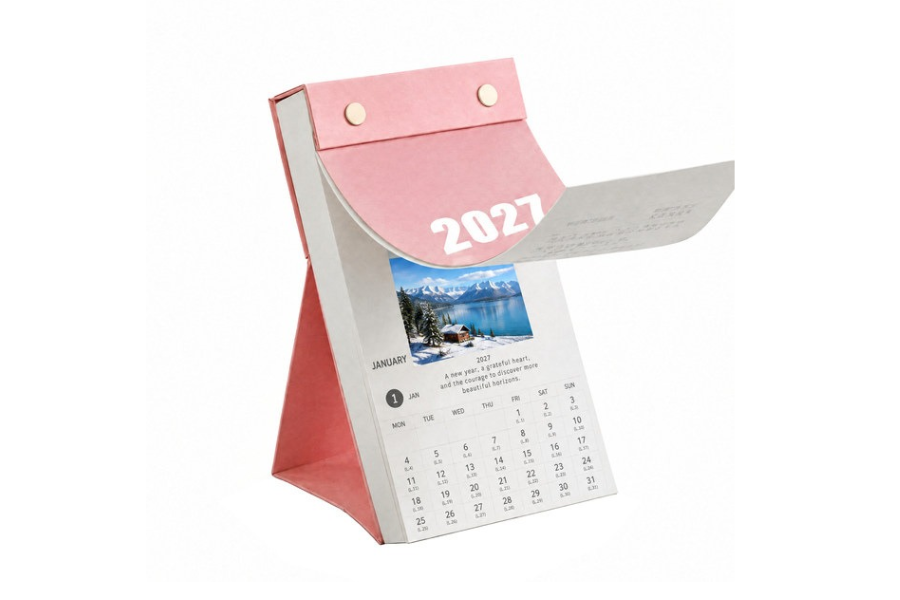
| Desk tent calendar | ca. 8.5 × 5.5 In (ca. 216 × 140mm) | — (stands on an easel base) | All markets |
| Single-sheet year planner (A2) | — | 16.54 × 23.39 In (420 × 594 mm) | Vereinigtes Königreich, EU, Australien |
| Single-sheet year planner (A1) | — | 23.39 × 33.11 In (594 × 841 mm) | Büros, Schulen |
| Magnetic fridge calendar | ca. 13 × 9.5 In (ca. 330 × 241mm) | — | Australien, UNS |
Notes for buyers:
- When suppliers quote calendar sizes, always confirm whether they mean the closed or open size. Many quoting mistakes come from mixing the two.
- Desk calendar and fridge calendar sizes vary between programs. The figures above are typical sizes, not fixed standards.
- Leave room on the wall layout for a hanging hole or hanger and for the binding margin. These take up space at the top edge of every page.
Calendar Sizes by Market
Size is only part of market fit. Week start, Feiertage, measurement units and even seasonal imagery all change from one region to the next. If you sell into several markets, plan these versions before artwork begins, not after.
United States and Canada
- Dominant sizes: 12 × 12 in square wall calendars (opening to 12 × 24 In) Und 11 × 8.5 in letter-size calendars (opening to 11 × 17 In). Mini 7 × 7 in formats are popular for gift and impulse retail.
- Week start: Sunday.
- Units: Specifications in inches. Retail buyers and distributors expect inch-based dimensions on spec sheets and packaging.
- Holidays: US federal holidays as standard. Canadian programs need Canadian holidays, and bilingual English/French date grids for some customers.
- Promotional use: Business calendars are commonly ordered in the fourth quarter and mailed or handed to customers around November and December. Delivery timing matters as much as the size itself.
Vereinigtes Königreich
- Dominant sizes: A4 (opening to A3) and A3 wall calendars. Slim DL and long formats are common for family organisers and promotional mailings.
- Week start: Monday.
- Units: Millimetres and ISO A-series paper. Using US sizes in the UK often looks wrong to retail buyers.
- Holidays: UK bank holidays. They differ between England and Wales, Scotland and Northern Ireland, so decide which version you print or mark them by region.
Europa (EU)
- Dominant sizes: A4, A3 and A5, plus a range of portrait and landscape art calendars from publishers.
- Week start: Monday, following the ISO 8601 Standard, with ISO week numbers often printed on the grid. German-speaking markets in particular expect them.
- Sprache: Month and day names need to be localised. Multilingual grids (for example English, Französisch, German and Spanish) let one print run serve several countries, but they take up more space in each day box.
- Holidays: Public holidays vary by country, and in Germany even by federal state. Many pan-European programs leave holidays off the grid for this reason.
Australia and New Zealand
- Dominant sizes: A4 and A3 wall calendars, A2 year planners for offices and schools, and magnetic fridge calendars for households and local businesses.
- Week start: Both conventions are in use. Confirm the preference with your retail or promotional customer.
- Units: Millimetres and A-series paper.
- Holidays and content: Public holidays differ by state and territory. School term dates are a strong selling point for family calendars. Seasonal imagery has to follow the southern hemisphere: December is summer, not snow.
- Format note: Australian online marketplaces list many magnetic calendars and planners for the fridge, which suggests that part of the household calendar market in Australia sits on the fridge rather than the wall.
How Size Impacts Printing Cost and Shipping
From the factory floor, two calendars with the same page count can differ a lot in price because of their size. These are the factors we look at first when we quote.
Sheet Utilisation Comes First
Calendars are printed on large parent sheets, which are then cut down. The cost question is how many finished pages fit on each sheet, and how much paper is cut away as waste.
- A size that fits neatly onto a standard parent sheet uses nearly all of the paper.
- A size just a few millimetres too large may force fewer pages per sheet, which can raise the paper cost per unit sharply.
- Practical advice: Before you lock in a custom size, ask your manufacturer for the „most efficient size“ close to your target. Moving the size by 5–10 mm often lowers cost without visibly changing the design.
Bigger Formats Need Heavier Paper
A small calendar on thin paper is fine. An A3 or 12 × 24 in hanging calendar on the same paper will curl, flutter and tear at the hanging hole. Larger formats usually need heavier stock to hang flat, which raises both paper cost and shipping weight.
Paper finish matters too. End users who write on their calendars prefer matte or uncoated paper for the date grid, because gloss coatings smudge ballpoint ink and some papers let fountain pen ink bleed through. A common approach is to print the image pages on coated stock and the grid on paper that is easy to write on, or to choose a matte stock throughout.
Page Count Multiplies Everything
A standard 12-month wall calendar usually has a cover plus 12 month pages, and some programs add a 13th month or a year-at-a-glance page. 16-month and 18-month calendars add pages, cost and thickness. Thickness matters at the binding stage, as the next section explains.
Finishing and Add-Ons
Hangers, drilled holes, varnish, foil on the cover, custom envelopes, shrink-wrapping and individual polybags all add cost. Most of these costs grow with the size of the calendar, so a feature that is cheap at A5 can become a noticeable line item at A3.
Freight Is Driven by Volume and Protection
For export orders, the shipping cost depends on carton dimensions and weight as much as on the product itself.
- Closed size ships, not open size. A 12 × 24 in hanging calendar ships at 12 × 12 In. Folding and stacking formats ship far more efficiently than single-sheet A2 or A1 planners, which must be rolled in tubes or shipped flat in large cartons.
- Carton count per pallet or container is the real number to compare between sizes. A slightly smaller calendar can fit more units per carton and more cartons per pallet.
- Protection prevents complaints. End-user reviews of promotional calendar suppliers mention crushed carton corners and creased calendars. For large formats, specify corner protectors, stiff board inserts, inner packs and correctly rated outer cartons. A cheaper carton is rarely cheaper once replacement stock is counted.
- Mailing programs: If your customers will post the calendars on to their own clients, design the size around standard mailer and envelope dimensions in the destination country. A calendar that does not fit a standard envelope can cost more in postage than it cost to print.
Binding Options by Calendar Size
Binding is where calendar size and page count meet the factory’s tooling. The table below maps the four production bindings to the formats where they are most economical and functional.
| Bindung | Am besten für | Kosten |
| Saddle stitch calendar | 8.5 × 11 in economy wall; A4 wall or smaller | Lowest |
| Wire-o (twin-loop) calendar | 12 × 12 In, 11 × 8.5 In, A4 and A3 wall calendars, and desk tent calendars | Medium |
| Gepolstert / glued head calendar | Fridge calendars, desk pads and small A5 or DL formats. | Varies by specification |
FAQ About Calendar Sizes
In the US and Canada, the most common wall calendar size is 12 × 12 Zoll, which opens to 12 × 24 inches when hung. In the UK, Europe and Australia, A4 (210 × 297 mm), opening to A3 (297 × 420 mm), is the most widely used format.
A4 that opens to A3 is the better all-round choice. It is cheaper to print and ship and fits standard packaging.
Compact formats that fold or stack flat, such as A4 and 11 × 8.5 in wall calendars or A5 desk calendars, are the most freight-efficient.
Our standard MOQ for custom calendars is usually 200 Kopien.
Specify protective packing at the quoting stage: corner protectors, stiff board inserts, inner packs or shrink-wrapping, and outer cartons rated for export.